14 Inspiring LinkedIn Summaries (And Tips to Improve Yours)

You might not have been caught red-handed scrolling LinkedIn in the middle of the day at work, but we know you are guilty of that. Probably we all are! And it is not even our fault; some profiles and LinkedIn summaries are so magnetic that you can’t help but stop and read.
Whether it is a witty one-liner or a deeply personal story of career transformation, a great LinkedIn summary does more than just list skills. It starts a conversation. If your own ‘About’ section currently feels like a dry recitation of your resume, don’t worry!
Here are 14 inspiring LinkedIn summary examples to spark your creativity, along with actionable tips to help you write a bio that people actually want to finish reading.
14 LinkedIn Summaries to Help You Improve Yours
Let’s not lie. We are all undeniably awkward when it comes to writing about ourselves. Perhaps this is why it is usually the task that stays at the bottom of the to-do list, buried deep.
- Headshot? Fixed it already.
- Headline? Done and dusted.
- Summary? ‘I’ll get to it once I have cleared my inbox and had a third cup of coffee. Or maybe I will just do it later on the weekend.‘
(Spoiler: the latter never comes)
So, now your profile has a blank or boring About section. You might think it is okay to leave it like that, but we want to warn you. This is a missed connection. You are basically self-sabotaging your success unintentionally.
The Good News?
You don’t have to stay stuck with an empty box. Below are 14 standout summaries that read like they were written by a LinkedIn profile summary maker. Each one belongs to a professional who is thriving in the corporate world, and together they show how a few well-chosen lines can turn your profile into an open door rather than a dead end.
Four Expert-Approved Approaches
Example 1: Desiree Thompson
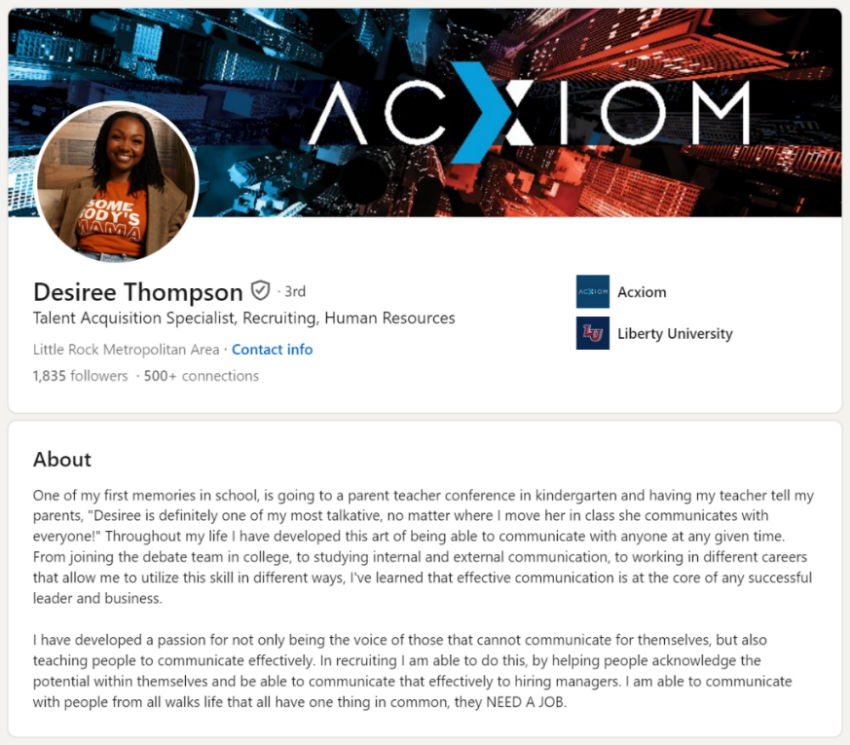
Currently a talent acquisition specialist, this young HR professional was once a very talkative student in Montessori. She has one of the most interesting LinkedIn summaries, where she talks about how she was a people person from the very beginning
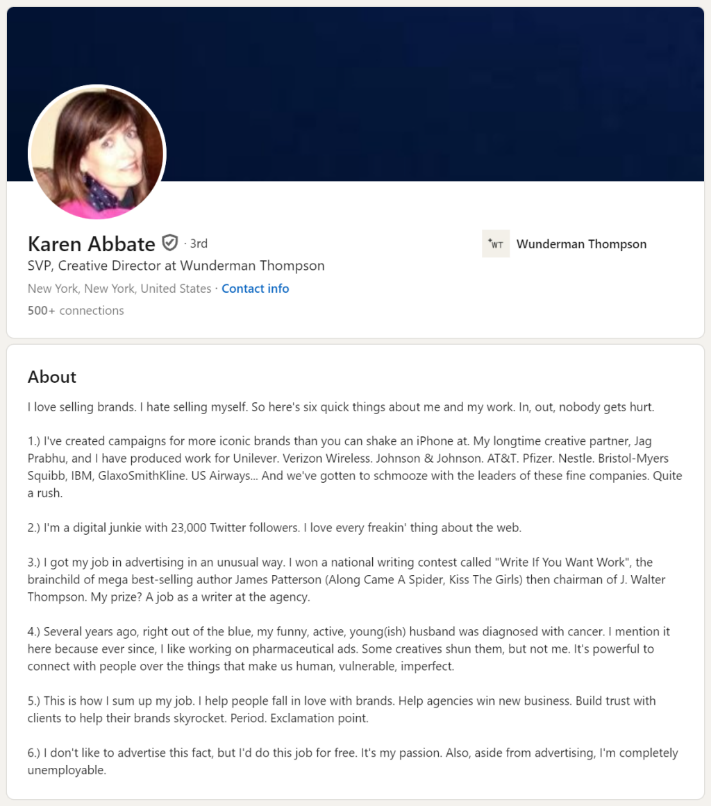
Example 2: Karen Abbate
She is a creative director at Wunderman Thompson. In her about section, you can see how she leads with her greatest accomplishments and uses her vulnerable story of finding a career in pharmaceutical advertising.
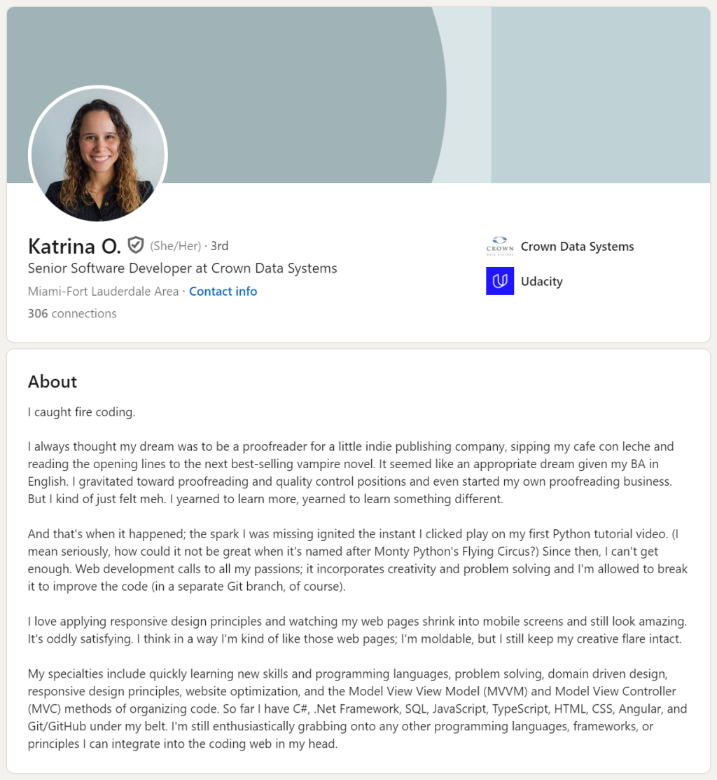
Example 3: Katrina O.
Senior Software Developer at Crown Data Systems, Katrina used to dream about being a proofreader. She mentions on her profile how ‘oddly satisfying’ her job is for her.
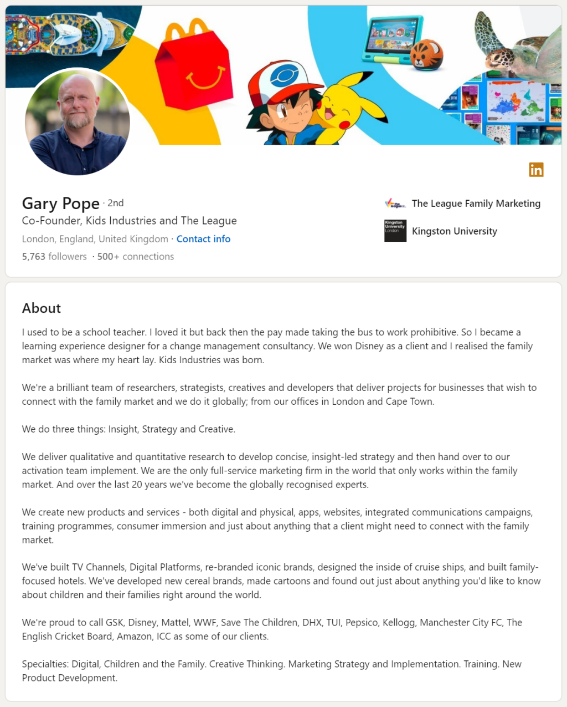
Example 4: Gary Pope
He writes about how he was a teacher in a school and was enjoying his life until it took a turn and made him the co-founder of Kids Industries and The League. We bet you will be hooked by how drastically his path changed from teaching to starting his own company.
v The Results-Driven Leader
This is the straight-to-the-point method. It uses clear bullet points and hard data to showcase your biggest wins, making it incredibly easy for recruiters to see your value. This approach can be a little tricky, though. But you have nothing to fear when a reliable CV consultant is near?
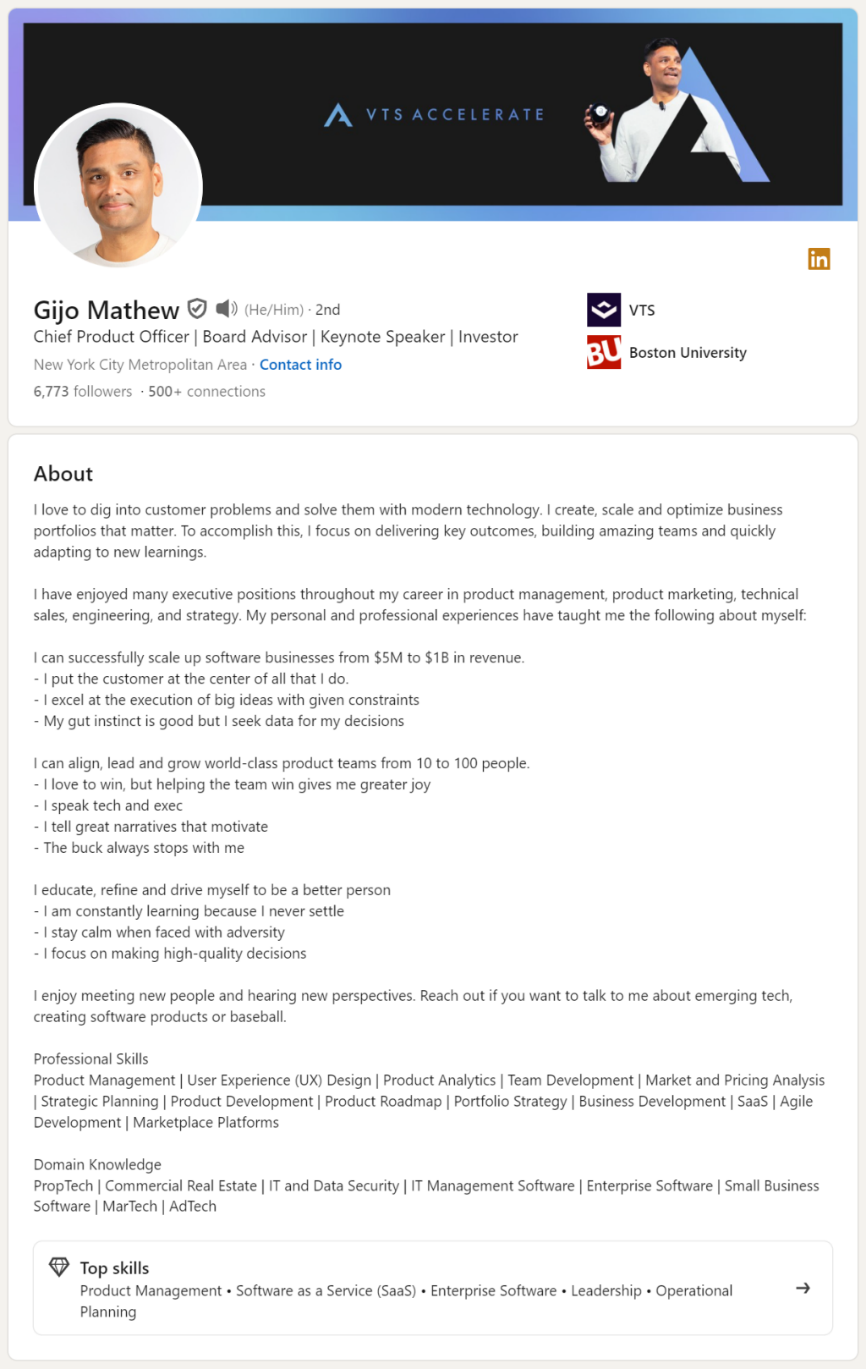
Example 5: Gijo Mathew
When Gijo, the Chief Product Officer, mentions that he loves digging into the customer problems, he is telling you how invested he is in his work. He proceeds to jot down all the results he has driven until now for reliability. This is exactly how your bio must look.
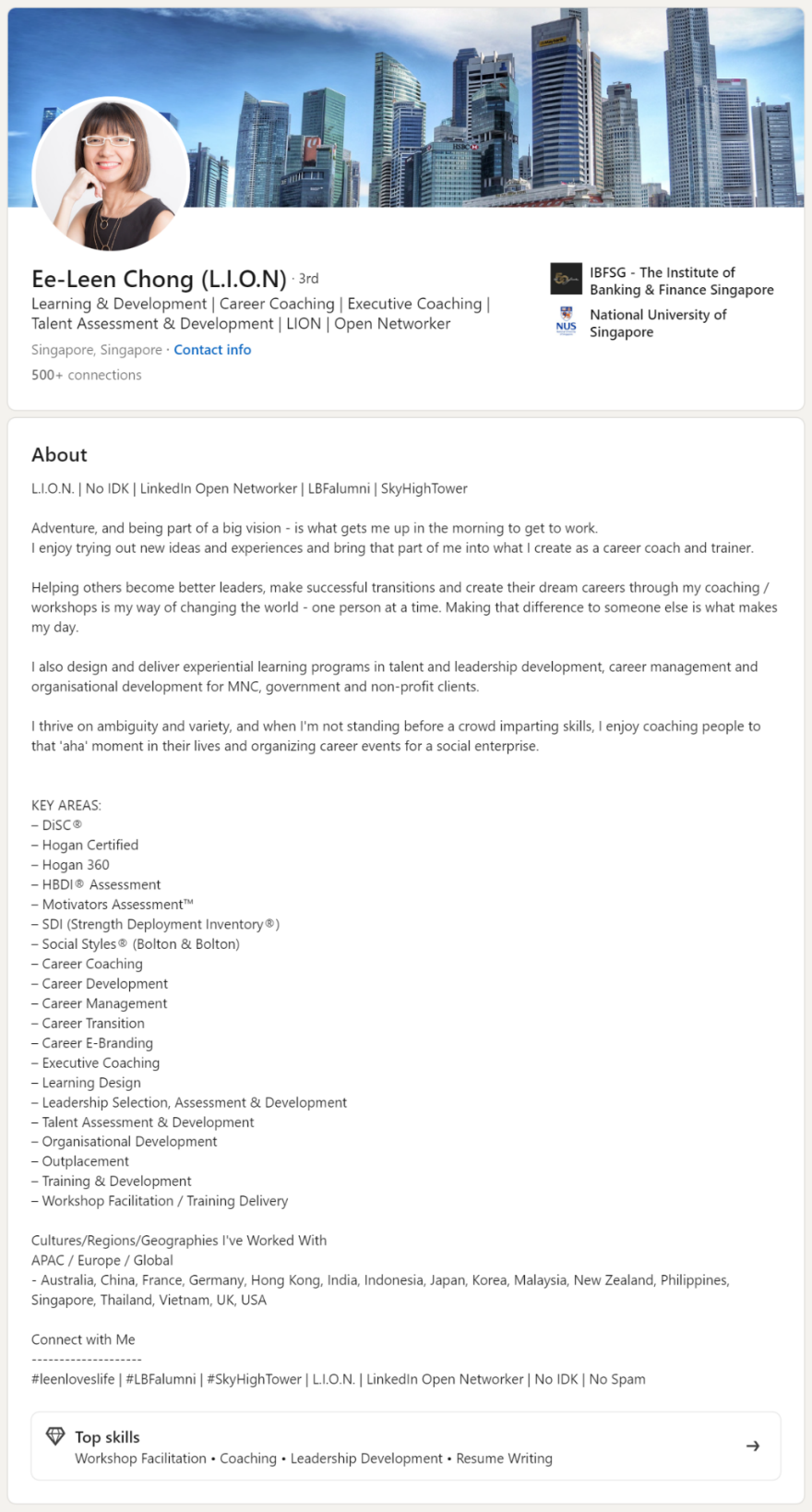
Example 6: Ee-Leen Chong
Career Coach Ee-Leen uses the same trick and provides a detail of her program without wasting any time. She uses clear bullets and breaks paragraphs often in her summary to increase readability. You can see how she conveys her global L&D experience by listing the cultures, regions, and geographies she’s worked with.
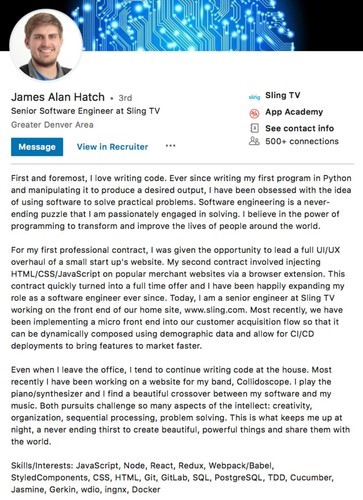
Example 7: James Alan Hatch
He is a Senior Software Engineer at Sling TV and professionally positions his work history as a series of advancements. Learn from him how he describes a current project to explain his role and value. It is evident that not every reader will follow, but his target audience will.
v The Problem Solver
Forget a list of duties; this focuses on outcomes. It identifies the specific pain points your industry faces and explains exactly how your unique skills swoop in to fix them.
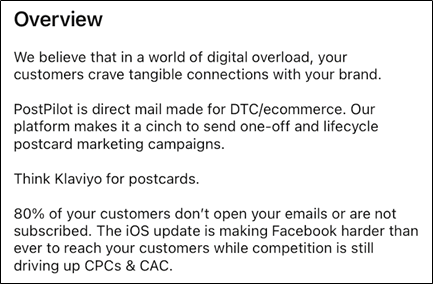
Example 8: PostPilot
Notice how PostPilot uses the specific pain point of 80% customers not opening emails. The business psychologically trains the reader to choose PostPilot for digital connections.
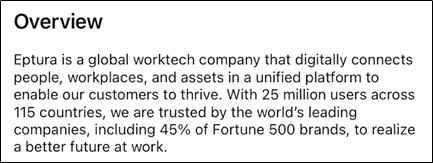
Example 9: Eptura
This is another example where the global worktech company Eptura shares how they help people connect digitally in a unified platform. The summary also talks about the massive number of users in millions who trust this brand. The client will quickly place their trust in you if you also use information like this about yourself.
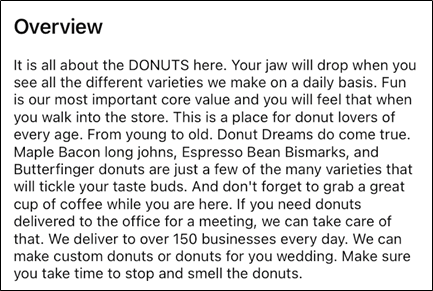
Example 10: Sandy Donuts and Coffee Shop
This donut-selling brand also cleverly writes in its summary about how customers can get a variety of donuts on a daily basis. You should also notice how they use the phrase’ place for donut lovers of every age.’ They are basically catering to all age groups, inviting more attention.
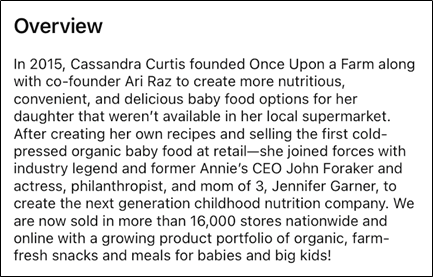
Example 11: Once Upon a Farm
This is a classic example of how someone who was initially facing a child-food problem themselves founded Once Upon a Farm. The best example of sharing pain points is: ‘delicious baby food options for her daughter that weren’t available in her local market.’
v The Passionate Learner
Perfect for fast-moving industries. LinkedIn summaries with such an approach highlight your curiosity and your ability to master new tools quickly, proving that you are not just experienced but also future-proof.
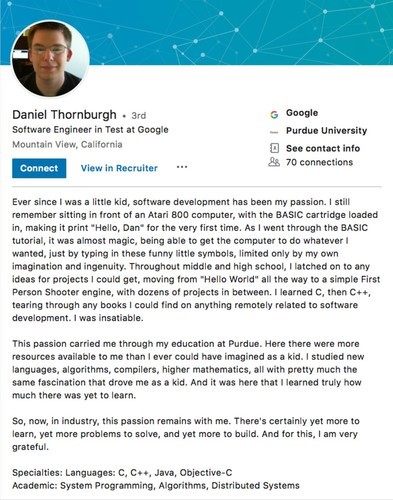
Example 12: Daniel Thornburgh
Daniel is a software engineer in Test at Google. In his summary, he starts talking about his childhood passion and then connects the dots to his career path. He mentions how he was curious and still looks forward to more future problems to solve!
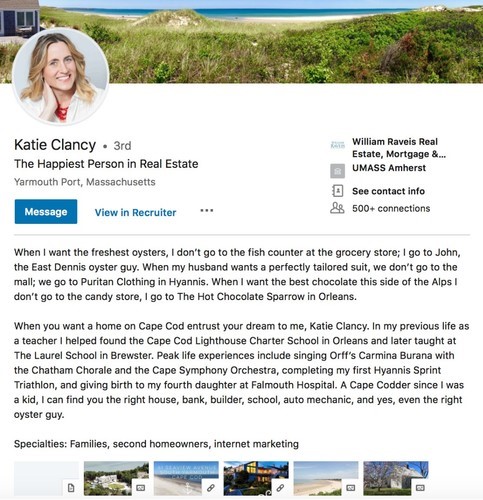
Example 13: Katie Clancy
Speaking to her property-seeking audience, Katie mentions how she is not just a real estate agent, but a trusted advisor too. She smartly places herself as your friend through her bio so that she appears friendly and reachable for every client. You need to do the same!
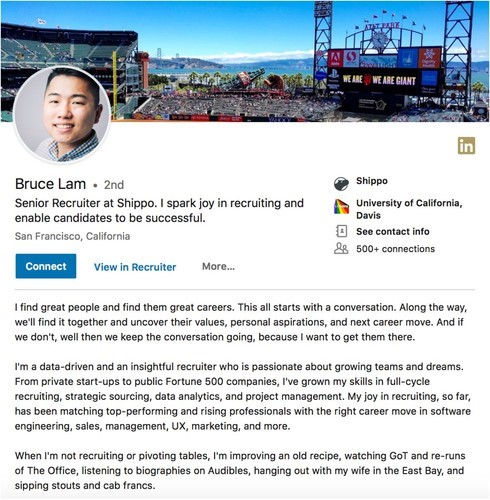
Example 14: Bruce Lam
Senior Recruiter at Shippo, Burce has a successful career. You need to learn from his summary writing style, how he opens strong with a description of his job in his own words. Next, notice how he shares his recruiting approach and mindset.
All this is practical information for candidates looking at his LinkedIn profile. When you write yours, you must also use the same tone and capture employers’ attention.
Here Are Some Improvement Tips
| Instead of This (The Mistake) | Do This (The Solution) |
| Walls of text that are hard to scan | Use white space and short 2-line paragraphs |
| Third-person (John is…) writing | Use I and me to sound human and approachable |
| Buzzword overload (e.g., Synergy) | Show results with specific examples or data |
| Repeating your resume | Tell the why behind your career choices |
| Ending abruptly without a next step | Add a Call to Action (e.g., Let’s connect!) |
FAQs to Help You Get Started
How long should my LinkedIn summary actually be?
Aim for 200 to 400 words. You want enough detail to show your personality and value, but keep it punchy enough that a busy recruiter can scan it in under 30 seconds.
Should I write my summary in the first or third person?
Always use the first person (I am, I help). LinkedIn is a social networking site, not a textbook. Hence, speaking directly to your audience makes you feel more approachable and human.
What is the most important part of the entire summary?
The first two lines are critical. Since LinkedIn clips the text, those opening sentences must act as a hook that convinces the reader to click ‘See more’ and read your story.
Wrapping It All Up
At the end of the day, your LinkedIn summaries are the only place on your profile where you get to control the narrative. So, stop treating it as a place to dump keywords you couldn’t fit into your job titles. It is basically a space to show who you are as a person behind the professional. Moving on, it’s up to you whether you tell a story or stick to the hard facts and figures; the goal is the same: make it easy for the right person to reach out. Finally, stop overthinking the perfect sentence and just start writing!